

Kalna Rajbari Temple Complex
Overview and History
The town of Ambika Kalna gets its name from the presiding deity, Goddess Ambika. While the town's history stretches back centuries, its pinnacle of glory was reached in the late 18th century under the patronage of the Bardhaman Raj. Maharaja Tej Chandra Bahadur, in particular, was instrumental in the construction of many of the temples seen today.
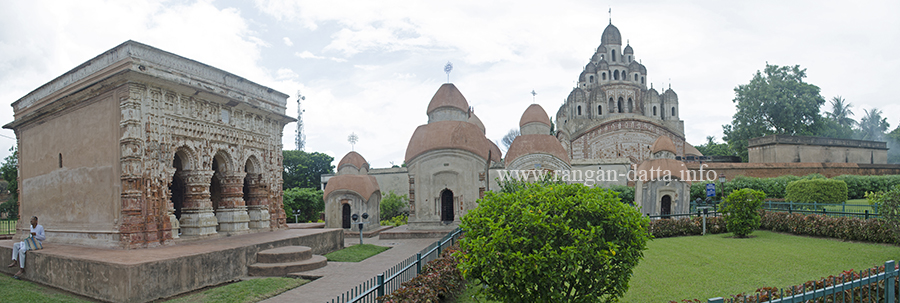
The Rajbari (royal palace) itself was once a significant center of power, and while the palace structures are mostly in ruins, the temple complex within and around it remains remarkably preserved. A key aspect of these temples is the extensive use of terracotta – baked clay tiles with intricate carvings. Since stone was scarce in the region, local artisans perfected this technique, transforming ordinary bricks into magnificent canvases for religious narratives, mythological episodes from the Ramayana and Mahabharata, social scenes, and even erotic depictions.
Key Details
The Kalna Rajbari Temple Complex is essentially divided into two main areas: the Rajbari complex itself and the separate Naba Kailash (108 Shiva Temples) complex directly opposite it.
Within the Rajbari Complex:
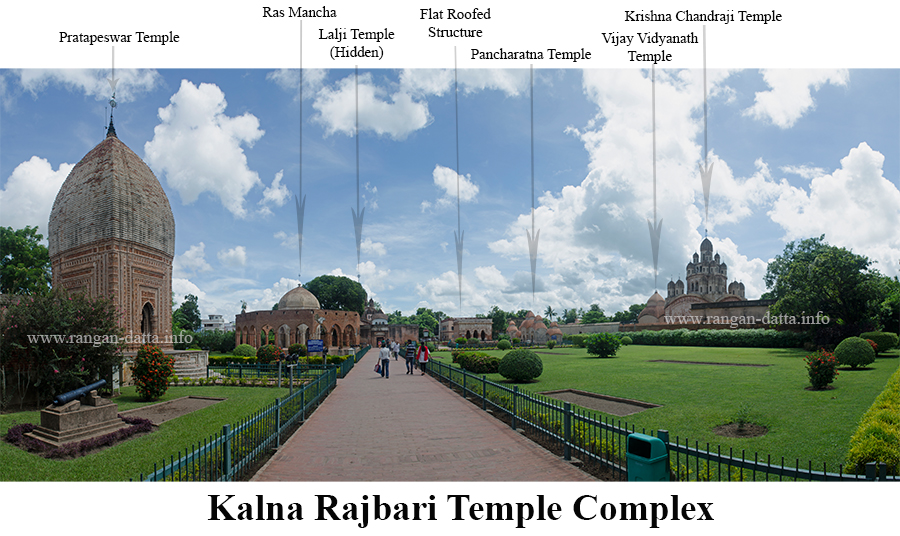
Lalji Temple (1739 CE)
- Architecture: This is the oldest structure in the complex and one of the most significant. It's a Panchabimsati Ratna temple, meaning it has 25 pinnacles (or "ratnas"). This is a rare architectural style, with three stories, culminating in a central pinnacle. The distribution of pinnacles is typically 12 on the first story (3 at each corner), 8 on the octagonal second story (1 at each corner), 4 on the third story (1 at each corner), and a single central one.
- Terracotta Work: Features intricate terracotta carvings depicting scenes from Hindu mythology and daily life, including sometimes erotic themes.
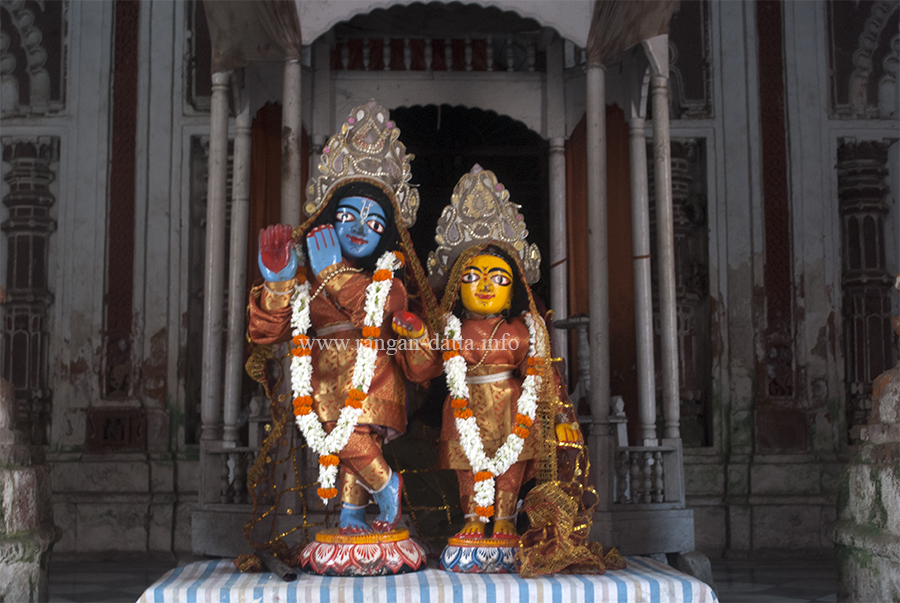
- Significance: Built by Maharaja Kirti Chand Rai for his mother, Braja Kishori Devi. It houses idols of Radha and Krishna.
Pratapeswar Temple (1849 CE)
- Architecture: Though smaller, it's considered one of the most ornate temples in the complex. It's built in the Rekha Deul style, characterized by a curvilinear shikhara (spire) and a single arched entrance. It stands on a high podium.
- Terracotta Work: Exceptionally detailed terracotta panels adorn its four walls, depicting various gods and goddesses, scenes from the epics (like the battle of Rama and Ravana, Mahishasuramardini), and even war scenes and daily life.
- Significance: Built by Pearykumari Devi, first wife of Raja Pratapchand.
Krishna Chandra Temple (1751–1752 CE)
- Architecture: Similar in structure to the Lalji Temple, also being a Panchabimsati Ratna (25-pinnacled) temple. It has an extended "atchala" (eight-sloped roof) type verandah with three decorated entrances.
- Terracotta Work: Its terracotta walls depict scenes from the epics.
- Significance: Built by Raja Trilokchand in the name of his mother, Lakshmikumari Devi, dedicated to Krishna and Radha.
Rasmancha
- Architecture: An octagonal structure with triple-arched entrances on each side, leading to a hexagonal pavilion crowned with a dome. The roof, however, is now destroyed.
- Significance: This structure was historically used as a platform for the annual Ras festival, where the deities of Lalji Jiu and Madan Gopal Jiu were brought for public viewing and cultural programs.
Giri Govardhan Temple (1758 CE)
- Architecture: Unique for its roof, which is meticulously designed to resemble a mountain, adorned with deities and animals like tigers, lions, crocodiles, and serpents.
- Significance: Pays homage to Govardhan Hill, associated with Lord Krishna. The temple depicts scenes of Krishna's life around the hill.
The 108 Shiva Temples (Naba Kailash)
Located just across the road from the main Rajbari Complex, this is perhaps the most unique and visually striking feature of Kalna.
- Architecture: Built in 1809 by Maharaja Tej Chandra Bahadur, this complex consists of 108 small 'Atchala' (eight-sloped roof) brick temples arranged in two concentric circles.
- The inner circle has 34 temples.
- The outer circle has 74 temples.
- All Shiva Lingams in the inner circle are white marble, while those in the outer circle alternate between white marble and black stone.
- An ingenious design allows all 108 Shiva Lingams to be visible from the center of the complex. There's also a covered well at the very center of the inner circle.
- Significance:
- The number 108 is highly sacred in Hinduism and other traditions, representing cosmic completeness, spiritual enlightenment, and the beads on a prayer mala.
- The arrangement is said to symbolize a rosary (mala).
- The different colored lingams are believed to represent the two aspects of Lord Shiva: the black lingams symbolize his Rudra (angry/destructive) form or the material/outer world with its complexities, while the white lingams represent his calm/benevolent aspect or the purity and inner peace of the soul.
- It is believed that worshipping at these temples purifies the soul and leads to spiritual liberation.
Visiting Information
Location: Ambika Kalna, Purba Bardhaman district, West Bengal. It's on the west bank of the Bhagirathi River.
Best Time to Visit: October to March, when the weather is pleasant.
Timings: The temples are generally open from sunrise to sunset.
Entry Fee: There is no official entry fee for the complex itself, as it's an ASI-protected site. However, donations are often accepted by local priests.
How to Reach:
- By Train: Kalna is well-connected by local trains from Howrah Station (Kolkata). The journey takes approximately 2–2.5 hours. From Kalna station, you can take a rickshaw or auto-rickshaw to the temple complex.
- By Road: It's about a 2–3 hour drive from Kolkata. You can hire a private car or take a bus.
Visitor Reviews
No reviews yet. Be the first to review!