
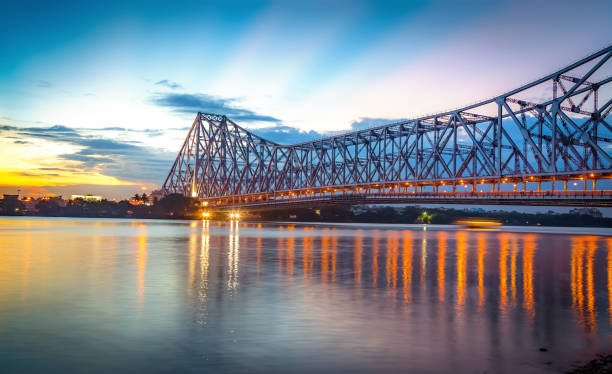
Howrah, a bustling metropolis and a significant transportation and industrial hub, is situated on the western bank of the Hooghly River, directly opposite Kolkata. It forms a crucial part of the Kolkata Metropolitan Area. The city is one of the oldest and most populous in West Bengal, playing a vital role in the region's economy and connectivity. Its strategic location has made it a major gateway for people and goods entering and leaving Kolkata and its surrounding areas.
The most iconic landmark of Howrah is undoubtedly the Howrah Bridge (now officially known as Rabindra Setu), an engineering marvel and one of the busiest cantilever bridges in the world. Connecting Howrah with Kolkata, it is a symbol of the city and a vital artery for daily commuters. Adjacent to it is the Vidyasagar Setu (the Second Hooghly Bridge), another impressive structure that has helped ease traffic congestion. Howrah is also home to one of the largest railway stations in India, Howrah Junction, serving as a major terminal for both long-distance and suburban trains.
Economically, Howrah has a diverse base, encompassing engineering industries, manufacturing units (though many older industries have faced decline), and a thriving informal sector. The city is known for its numerous small-scale industries, including metalworking, foundries, and various types of manufacturing. The wholesale markets in Howrah are also significant centers for trade. While facing challenges related to urbanization and infrastructure, Howrah continues to be a vital part of the economic and social fabric of the Kolkata Metropolitan Area, with a large working population and a vibrant street life.